
by Camillo. M. Pessina – geologist 2026, May
Camillo Pessina is an Italian field geologist specializing in uranium metallogeny within the Permian volcano–sedimentary successions of the Central Southern Alps. His research is particularly focused on the Val Vedello district, where uranium mineralization is hosted in tourmaline-bearing cataclasites (boron metasomatism) developed along low-angle normal faults (LANFs) associated with late Variscan extensional tectonics, and subsequently reworked during the Alpine orogeny. His work integrates classical field/mining mapping with detailed structural analysis, petrography, and paragenetic studies to constrain the genesis of uranium mineralization within a high-temperature magmatic hydrothermal system linked to Early Permian magmatism, interpreted as magmatic-hydrothermal uranium system with IOCG affinities.
Unless otherwise stated, the technical and financial content presented on this website reflects the author’s independent research, interpretation, and synthesis of geological, mining, historical, and industrial sources.
Historical Mining Investments: A Necessary Benchmark
During the 1970s and 1980s, Italy invested billions of lire in uranium exploration, technological development, and the construction of strategic infrastructure related to civilian nuclear power. It was an ambitious industrial and scientific project designed to provide the country with greater energy independence, security of supply, and technological progress.
That trajectory was abruptly interrupted by political decisions that led to the gradual dismantling of Italy’s civilian nuclear sector. As a consequence, highly specialized expertise, industrial opportunities, and decades of massive public and private investments were lost.
This page — unique in its kind for the completeness of the financial and industrial data it presents — now stands as a historical document of extraordinary value. It does not merely record what Italy had managed to build, but also what it could have become within the European energy landscape.
Reading these data set “between the lines” means going beyond simple historical memory: it means reflecting on the strategic choices made in the past, their long-term consequences, and the future prospects of Italy’s energy policy.
Following the 1973–1974 energy crisis, intensified by the Arab-Israeli conflict and the closure of the Suez Canal, Italy — along with much of Europe — responded by attempting to reduce its energy vulnerability through new industrial and strategic initiatives.
Today, faced with geopolitical tensions potentially even more destabilizing — from the conflict involving Iran, Israel, and the United States to the risk of a prolonged closure of the Strait of Hormuz — Europe appears to lack a structural response comparable to the one developed in the 1970s.
Instead of a renewed long-term strategic vision, only one watchword seems to prevail: “save energy.”
Camillo M. Pessina – geologist 2026, May, 16
Una necessaria prospettiva storica
Negli anni Settanta e Ottanta l’Italia investì miliardi di lire nella ricerca mineraria dell’uranio, nello sviluppo tecnologico e nella realizzazione di infrastrutture strategiche legate al nucleare civile. Si trattava di un progetto industriale e scientifico di grande ambizione, concepito per garantire al Paese maggiore indipendenza energetica, sicurezza degli approvvigionamenti e progresso tecnologico.
Quel percorso venne però bruscamente interrotto da scelte politiche che portarono alla progressiva dismissione del nucleare civile italiano. Con esso furono disperse competenze altamente specializzate, opportunità industriali e decenni di investimenti pubblici e privati di dimensioni colossali.
Questa pagina — unica nel suo genere per completezza dei dati finanziari e industriali riportati — rappresenta oggi una testimonianza storica di straordinario valore. Non documenta soltanto ciò che l’Italia era riuscita a costruire, ma anche ciò che avrebbe potuto diventare nel panorama energetico europeo.
Leggere questi dati “tra le righe” significa andare oltre la semplice memoria storica: significa riflettere sulle scelte strategiche compiute nel passato, sui loro effetti di lungo periodo e sulle prospettive energetiche future del Paese.
Dopo la crisi energetica del 1973–1974, aggravata dal conflitto arabo-israeliano e dalla chiusura del Canale di Suez, l’Italia e gran parte dell’Europa reagirono tentando concretamente di ridurre la propria vulnerabilità energetica attraverso nuove strategie industriali.
Oggi, di fronte a tensioni geopolitiche potenzialmente ancora più destabilizzanti — dal conflitto tra Iran, Israele e Stati Uniti ai rischi di blocco prolungato dello Stretto di Hormuz — l’Europa appare invece priva di una risposta strutturale paragonabile a quella elaborata negli anni Settanta.
Al posto di una nuova visione strategica, sembra prevalere una sola parola d’ordine: “economizzare”.
Camillo M. Pessina – geologo 16 maggio 2026
VAL VEDELLO. Underground Operations & Financial Performance Summary 1976-1983
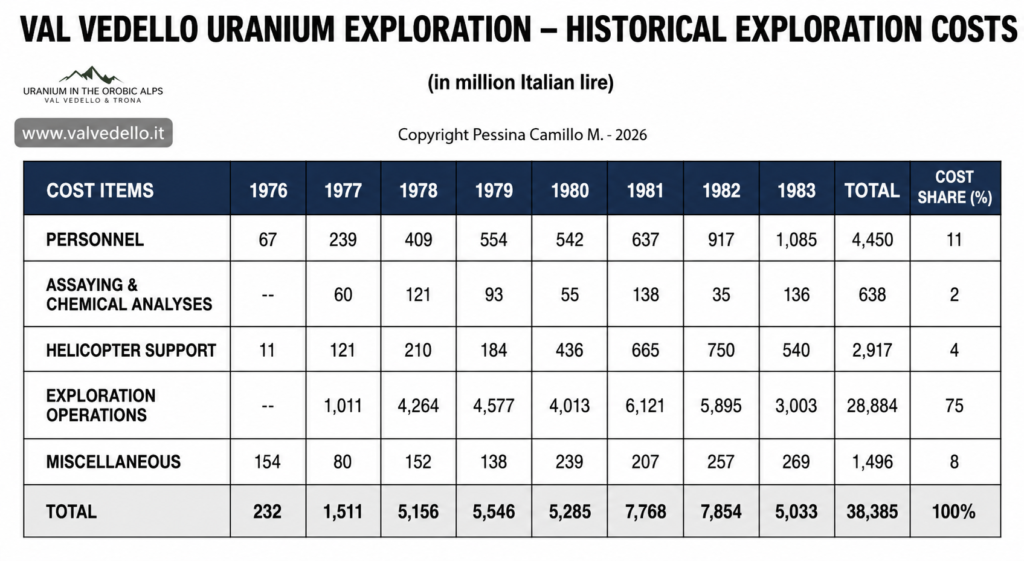
This first table is particularly significant as it outlines the overall financial framework of the entire Val Vedello uranium exploration program, rather than merely underground operating expenditures. The actual amount spent by AGIP at the time totalled 38,385 million lire, equivalent to 38.385 billion nominal Italian lire between 1976 and 1983. In present-day terms, this historical expenditure would correspond to an estimated purchasing power of approximately 167–170 billion equivalent lire, or roughly €86 million in 2026 values. (Pessina C.M.-2026)
Questa prima tabella è particolarmente interessante perché mostra il quadro economico complessivo dell’intero programma uranifero di Val Vedello, non solo delle spese operative sotterranee. La spesa realmente sostenuta da AGIP all’epoca fu pari a 38.385 milioni di lire = 38,385 miliardi di lire nominali anni 1976–1983. I 38,4 miliardi di lire spesi allora avrebbero oggi un potere d’acquisto comparabile a circa 167–170 miliardi di lire “moderne equivalenti”, oppure circa 86 milioni di euro 2026. (Pessina C.M.-2026)
Per dare un riferimento storico ancora più intuitivo:
Negli anni ’70:
* 38 miliardi di lire erano già una cifra enorme per l’esplorazione mineraria italiana
* molti progetti metalliferi nazionali dell’epoca operavano con budget nettamente inferiori
* questo conferma ulteriormente quanto Val Vedello fosse considerato strategico nel quadro energetico italiano post-crisi petrolifera 1973–79.
In termini moderni, AGIP stava finanziando Val Vedello con un’intensità economica paragonabile a un progetto junior/intermedio internazionale molto serio di esplorazione avanzata.
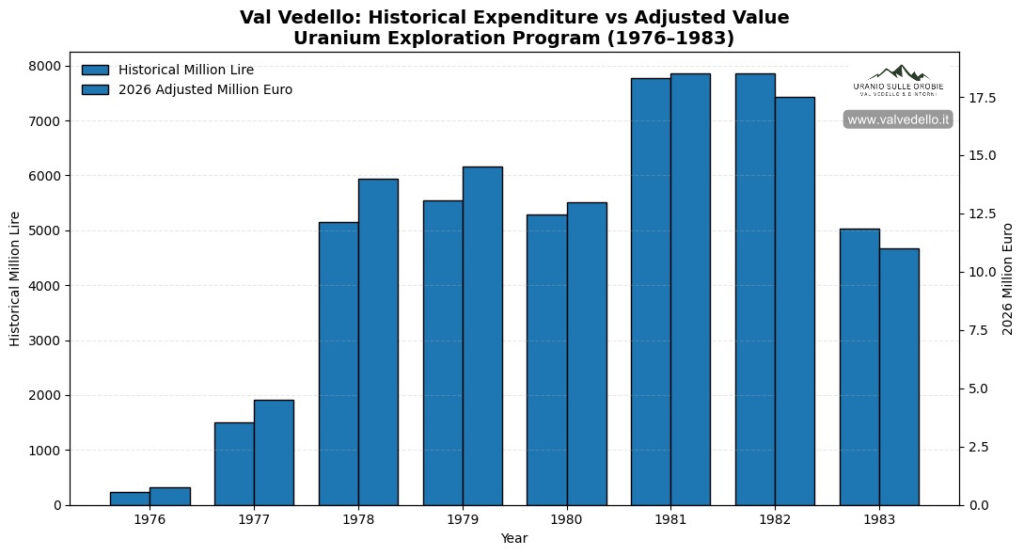
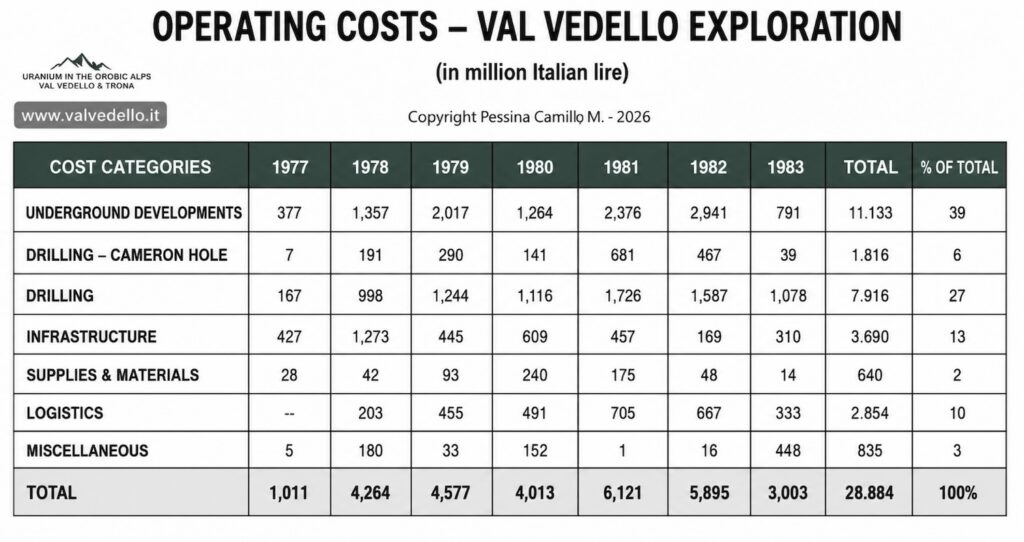
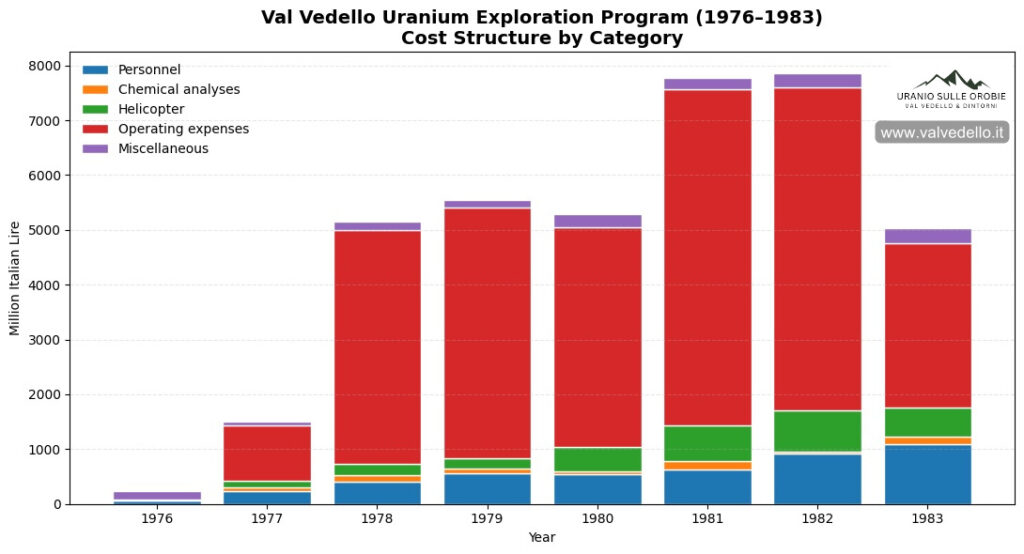
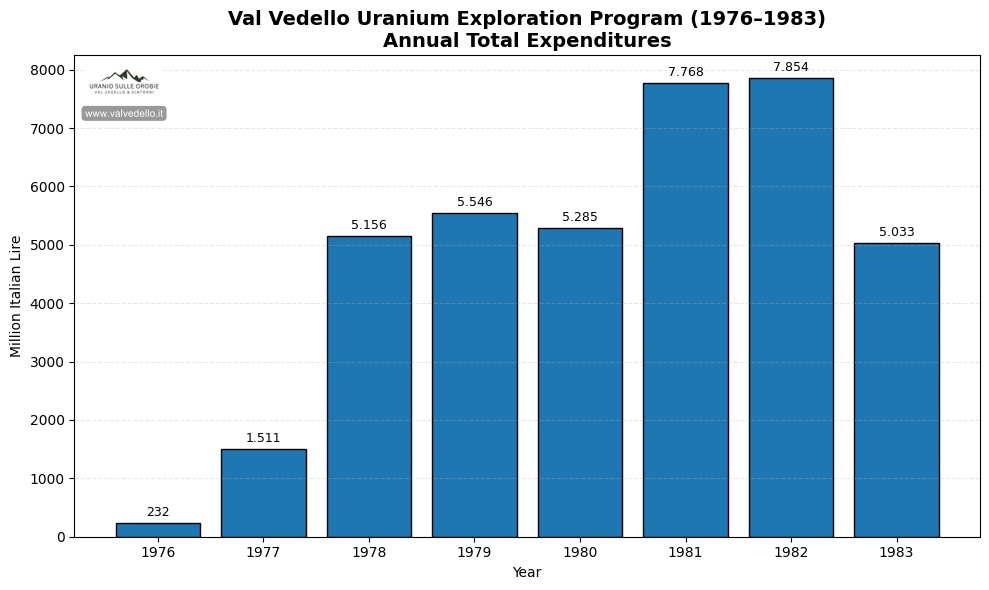
This second table is particularly noteworthy as it provides the financial picture of Val Vedello uranium exploration program, focusing solely on underground operating expenditures. A particularly significant figure is that operating expenditures (75%) clearly dominated the total budget of 38,385 million lire, confirming the highly capital-intensive nature of AGIP’s exploration activities at the site. From a historical mining perspective, the expenditure peak recorded in 1981–1982 closely reflects the period of maximum underground exploration intensity at Val Vedello, particularly in relation to tunnel development and drilling campaigns, in full accordance with the technical documentation available for the deposit. (Pessina C.M.-2026)
Questa seconda tabella è particolarmente interessante perché mostra il quadro economico complessivo dell’intero programma uranifero di Val Vedello delle spese operative sotterranee. Dato notevole: le spese operative (75%) dominano nettamente il budget totale di 38.385 milioni di lire, confermando quanto fosse capital intensive l’esplorazione AGIP nel sito. Osservazione interessante dal punto di vista storico-minerario: il picco di spesa nel 1981–1982 conferma molto bene la fase di massima intensità dell’esplorazione sotterranea AGIP a Val Vedello, soprattutto per sviluppo gallerie e campagne di sondaggio, coerentemente con quanto riportato nella documentazione tecnica del giacimento. (Pessina C.M.-2026)
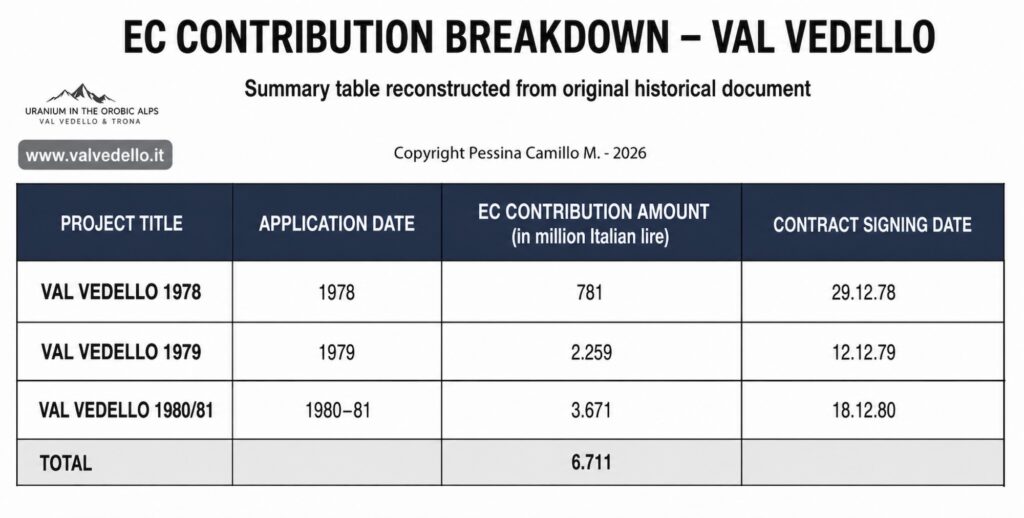
This table is historically significant as it demonstrates that the Val Vedello project was not financed solely by AGIP/ENI, but also benefited from direct funding from the European Economic Community (EEC), amounting to a total of 6,711 million lire at the time. Approximately 17.5% of the entire exploration program was therefore covered by Community funding. This is far from negligible and suggests that, between the late 1970s and early 1980s, Val Vedello was regarded as a strategic project within the broader European energy framework following the oil shocks. (Pessina C.M.-2026).
Questa tabella è molto significativa dal punto di vista storico: mostra che il progetto Val Vedello non fu sostenuto soltanto da AGIP/ENI, ma beneficiò anche di un supporto diretto della Comunità Economica Europea, per un totale di 6.711 milioni di lire dell’epoca. ≈ 17,5% dell’intero programma esplorativo fu coperto da fondi comunitari. È un dato tutt’altro che marginale: suggerisce che Val Vedello venisse percepito, tra fine anni ’70 e inizio anni ’80, come progetto strategico anche nel quadro energetico europeo post-shock petroliferi. (Pessina C.M.-2026)
Exploration Works
Radioactive anomalies were discovered in the Vedello Valley by the end of 1975 during a regional spectrometric aerial survey made by AGIP.
The following year some geological teams, suitably equipped to work at high altitudes, carried out detailed radiometric, geological and structural surveys of the area. On the base of the thus gained results, at the beginning of 1977 AGIP decided to carry out detailed underground exploration, after the required external preparation works.
During the summer of 1977, underground exploration of the main orebody had commenced with the driving of drifts on two levels, including strike drifts and crosscuts. The principal mineralized lode, consisting of a uranium- and polymetallic sulphide-bearing cataclastic–mylonitic horizon dipping eastward and southeastward, was explored from both the hanging wall and the footwall by means of upward and downward drill holes.
By year-end 1977, underground exploration works comprised 982 metres of lateral development and 3,351 metres of underground diamond drilling, which confirmed the vertical and down-plunge continuity of the orebody.
In 1978, a further 2,278 metres of underground development were completed, together with 10,087 metres of underground drilling. Exploration activities were primarily concentrated on Level 1. Drilling was conducted using inclined underground diamond drill holes collared from dedicated drill bays established along drifts developed parallel to the mineralized structure, on both the hanging-wall and footwall sides.
Mineralization has currently(end 1978) been confirmed over 400 metres vertically and approximately 600 metres along strike.